Adult Visitor Study
During the FiM project, we frequently heard questions like, “What about parents? How do we support them in not taking over, while still helping their children work through challenges?” These recurring questions led us to pursue this line of inquiry through a networked improvement community (NIC). A NIC involves a community of local practitioners using improvement science techniques to study a problem, design interventions, and review outcomes together.
We collaborated with six museums to co-develop and implement an intervention study focused on how informal educators can support parents and other adults during moments of failure—both their own and their children’s. Our initial goal as researchers was for the six organizations to reach consensus on a single research question that each would explore within its own context. We assumed that a shared question would generate more cohesive and powerful insights for the field of informal learning environments. However, through our discussions, it became clear that each organization approached the larger aim with distinct perspectives, needs, and capacities. Recognizing this, we shifted our approach. Rather than pushing for one unified research question, we invited each organization to frame its own problem of practice and driving question that reflected its unique context. To support this process, we asked partners to develop an aim statement and driver diagram to help operationalize their projects.
This shift—from uniformity to flexibility—proved to be both generative and well-received. As one partner reflected, “Looking at this holistically, I wonder if the fact that this is a group of informal science educators thinking about failure-positive learning and focused on supporting youth towards independent discovery and thinking lends itself to attracting people, like myself, who are particularly open to collaborative or non-hierarchical research structures.”
We have included a document with resources for those interested in developing and conducting their own research study to address a problem of practice.
Examples
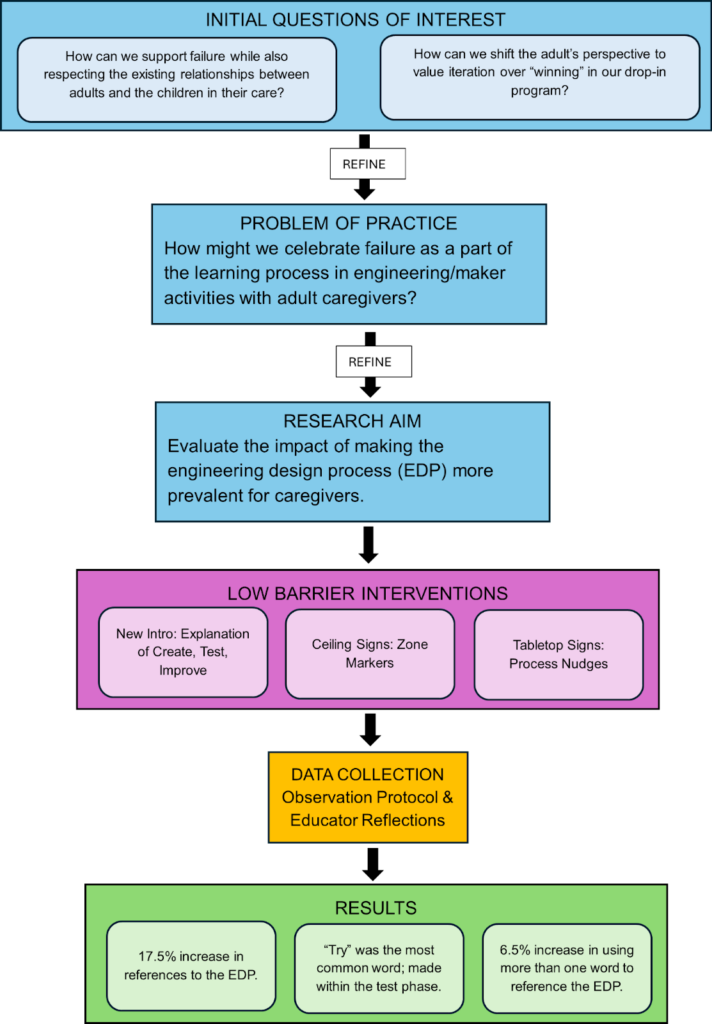
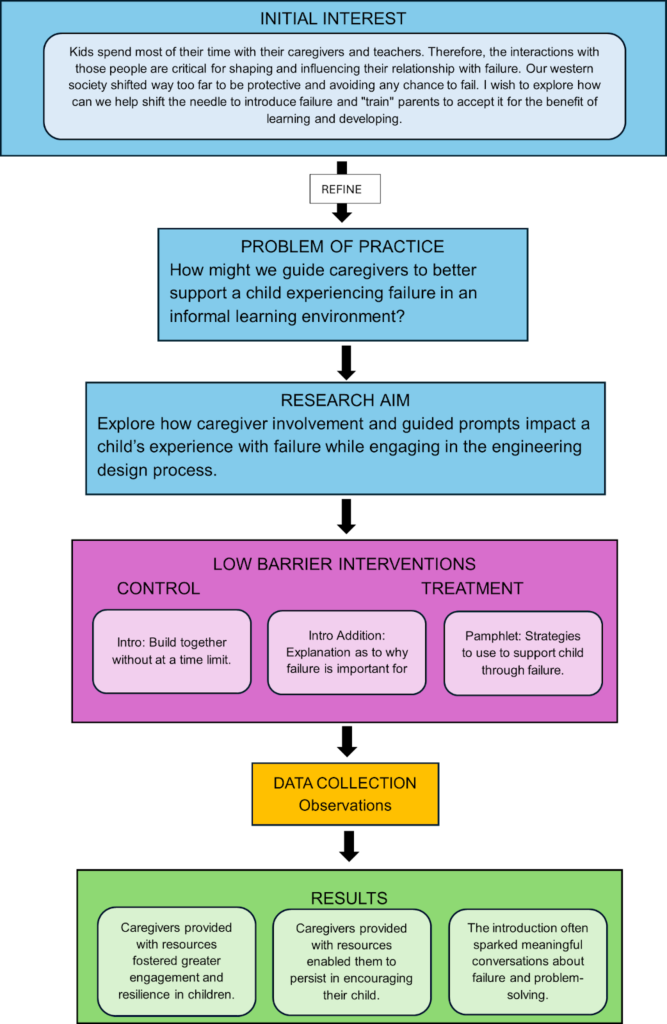
We provide two examples of this process from the Museum of Science (MOS) in Boston, MA and Museum of Science and Curiosity (MOSAC) in Sacramento, CA.
Example 1: Museum of Science
Example 2: MOSAC
What we learned through the individual research studies:
- Build a shared understanding of “failure” and how to recognize productive struggle.
- Develop strategies to guide caregivers in supporting children through learning challenges, as well as boost their engagement and persistence.
- Promote co-learning by engaging adults and children together in iterative, design-based activities.
- Encourage parallel participation of parents and children to increase engagement and normalize failure as part of learning.
- Implement caregiver prompts and framing of failure to boost children’s engagement, persistence, and resilience.
- Assign roles or jobs for each team member as a way to promote familial collaboration.
- Use “team” language to reinforce the idea of working together and collaborating.
- Align exhibit environments with institutional learning goals; make valued processes—like the Engineering Design Process—visible through clear, low-cost cues.