Museum of Science
Why Failure in Making?
We wanted our educators to have the opportunity to discuss best practices for facilitating engineering experiences and to specifically think about how to foster learning through failure. At the time, our education team was also transitioning back to working onsite with visitors after having spent the previous couple of years primarily running online programs. The project provided an important professional development opportunity for our educators to be better prepared to support our guests while facilitating open-ended engineering design activities.
For me, using filming as a tool for reflection to create professional development experiences that are more individualized as opposed to, again, us telling people this is best practice, go do this. I think it cemented the learning in a way that that approach wouldn’t have. (Lead Facilitator, Year 3)
What is Failure
Our engineering exhibits and programs invite visitors to think creatively, break down problems into smaller steps, and iterate on ideas to work towards solutions. The focus on iteration is particularly present in our Design Challenges program which engages visitors in the Engineering Design Process (EDP) as they ask, imagine, plan, create, test and improve prototype design solutions for a given challenge. We think of failure as a part of testing and improving where we can encourage visitors to make observations and make changes to their designs based on the test. We also try to help visitors recognize failure as a part of the iterative process and not as the opposite of success.
failure-based activity
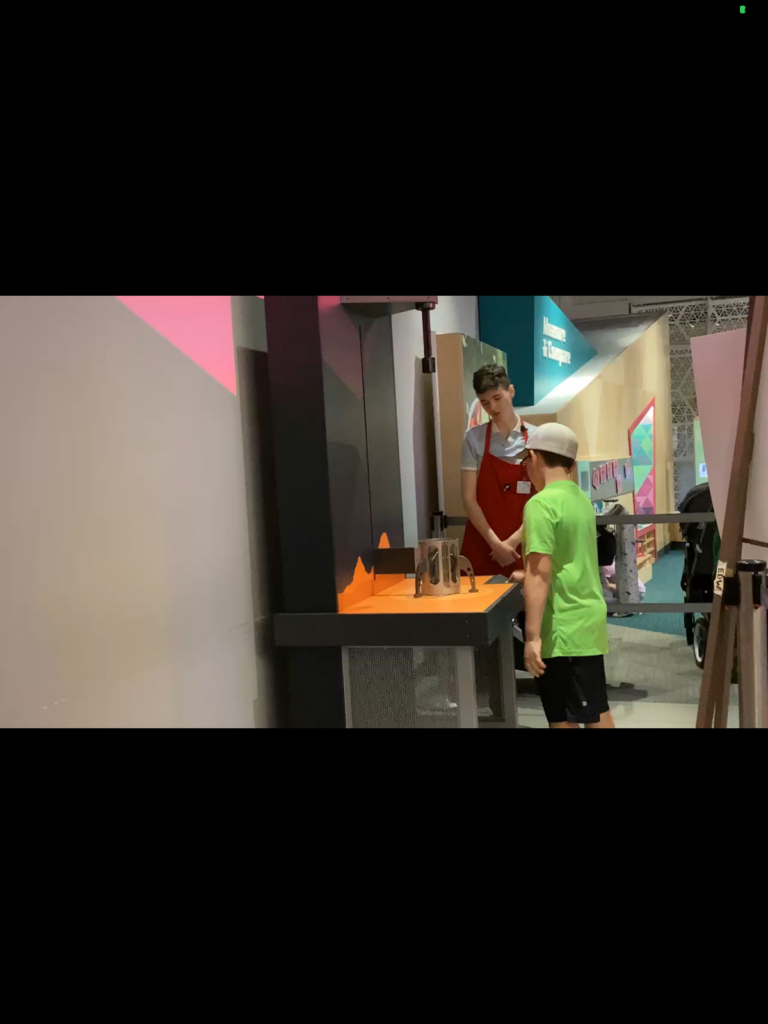
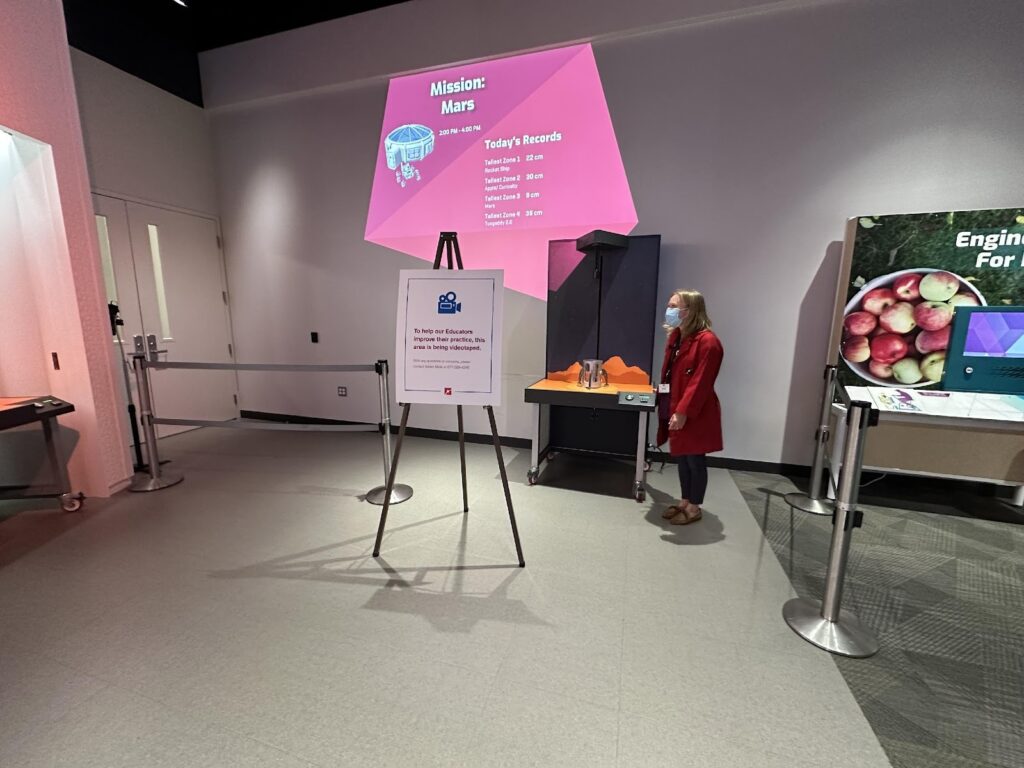
We focused on our Mission: Mars design challenge, which is a facilitated opportunity in our Engineering Design Workshop exhibit. The goal of the design challenge is to build a Mars habitat that can maximize volume, so be as big as possible, while also being able to fit inside of a space capsule (so that we can get it to Mars). The design also needs to stay structurally sound during the test so that the astronauts can live safely inside.
one failure moment or challenge
During our first workshop we were inspired to create our own version of the Pipe Cleaner Engineering challenge that was originally created by the Scott Family Amazeum. We decided to try using one of our regularly facilitated design challenge activities, Echo Base Bobsleds. While our Educators built, we introduced new design constraints to increase the challenge and make failure more likely. For example, without warning they were told that they could keep the binder clips that they already were using, but couldn’t have any additional. However, because they were so familiar with the challenge they were able to overcome all of the obstacles that we set in place and didn’t actually experience much failure. This in turn became a failure moment for the staff who planned and facilitated the workshop. We still debriefed with the Educators at the end of the activity and discussed why they were able to navigate the challenges so easily.
After this failure moment, we felt that it was still important for our Educators to have an opportunity to experience failure as a part of the professional development process so we adjusted our plans for the second Workshop. We decided to add the Pipe Cleaner Engineering challenge as it was written, which did accomplish our goal and enabled us to have the debrief conversation that we had originally planned for our first workshop.
What did We learn?
Being part of this process gave us a deeper awareness of how we support failure and how we talk about it with visitors, staff, and volunteers. We began to notice moments where we could intentionally validate a visitor’s experience of failure and use it as an opportunity to encourage persistence, creativity, and problem-solving. This awareness has now become part of our training conversations — when onboarding staff or volunteers, we share specific strategies for recognizing productive struggle, stepping back to let visitors work through challenges, and knowing when to step in to prevent overwhelming frustration.
Another key takeaway was the increase in self-reflection among our facilitators. As we worked through the process, we became more focused on observing individual visitor reactions and responding to their needs in the moment. The opportunity to use video was especially powerful. Having a structured reflection template and reviewing the footage soon after recording allowed us to see our practice from a new perspective and engage in richer discussions during Workshops three and four. This practice helped us move from simply describing what happened to analyzing our choices and brainstorming new approaches.
one insight or practice We Continue
On a practical level, we gained confidence in the logistics of filming while the public is present — something that initially felt daunting. By working through the technical and scheduling challenges, we created a system that felt comfortable for staff and that we can now reuse for professional development.
Additionally, through this project we began to recognize the power of focusing on a specific activity during professional development. We’ve adapted some of the materials that we developed during this project, to create a workshop for our Summer Youth Interns and have received a lot of positive feedback from our interns. The opportunity to think deeply about one specific activity, and brainstorm strategies for facilitating the inevitable moments of failure, enabled them to more confidently support visitors.
Adult Focused Study
Initial Questions and Interests
We train our educators to focus on supporting visitors through the Engineering Design Process and to celebrate redesign and iteration over creating a “winning” design. Despite this, we frequently find that the adults in our space continue to define success as “winning” the design challenge (e.g. getting the fastest bobsled time of the day) and focus heavily on the outcome rather than the iterative process. Whether the adults are visiting with school groups or their families there is often a tension between our aims and their definitions of success and related expectations. The social dynamics at play often result in a child then following their adult’s lead and focusing solely on “winning.”
One strategy that we’ve used to resolve this tension is to encourage adults to create their own designs, but this strategy is not always successful in redirecting their focus. This left our team wondering: How can we support failure while also respecting the existing relationships between adults and the children in their care? How can we shift the adult’s perspective to value iteration over “winning” – is that even possible in our space given the nature of our drop-in program? We were interested in answering these questions and building our capacity to negotiate these interactions. We hypothesized that shifting the adult’s perspective to value the design process and inevitable associated failures could potentially have a deeper impact on the children in their care.
What Was your Research Focus?
The aim of our study was to examine the impact of increasing the visibility of the Engineering Design Process (EDP) —particularly the steps focused on moments of failure (create, test, and improve)—on caregiver engagement. We anticipated that caregivers would shift their attention toward supporting the process rather than emphasizing a successful final product if they were explicitly informed that this was the purpose of the activity. To explore this, we implemented three interventions: (1) a revised introduction to explicitly describe the three EDP steps (create, test, improve) before presenting the specific challenge, (2) suspended signs from the ceiling to visually mark the location of each step in the space, and (3) placed a tabletop sign illustrating the process near the area where caregivers received the introduction and collected materials.
Due to the nature of our drop-in design challenge activities, there is no guarantee that a caregiver will actually interact with a Museum educator. We chose these interventions with the hope of still impacting these caregivers through the visual clues in the space.
What did your research highlight?
Our findings suggest that the revised introduction and signage had a positive effect on caregiver engagement. First, we asked whether these changes led caregivers to reference the Engineering Design Process (EDP) more often while supporting their children. The answer was yes: the proportion of caregivers referencing the EDP during the Soaring Satellite activity increased by 17.5%, rising from 28% to 45.65%—about 4% above our target of 41%. Second, we examined whether caregivers referenced a greater number of EDP steps. Here too, we observed improvement: there was a 6.5% increase in caregivers using more than one EDP term when interacting with their child.
What are the key takeaways of your research for the field?
A key takeaway from our work is the importance of aligning the physical environment with the values and learning goals of the institution. In our case, the Engineering Design Process (EDP) is the focus of the exhibit and the drop-in design challenge activities, but until this study it was not explicitly represented in the physical space. Adding simple, low-cost cues—such as hanging signs indicating EDP steps—had a measurable impact on how caregivers supported their children. For the field, we recommend being intentional about making valued processes or practices visible within exhibit spaces.
About us
To inspire a lifelong love of science in everyone.
As science and technology increasingly shape our lives, the Museum of Science strives to equip and inspire everyone to use science for the global good. Among the world’s largest science centers and New England’s most attended cultural institution, we engage nearly five million people a year – at Science Park and in museums around the world, in classrooms, and online.
The Museum’s singular location connecting Boston and Cambridge puts us at the junction of some of the world’s most influential academic institutions and industries, local and state government, schools, and the public. Trusted by each sector, we are ideally positioned to convene, inspire, and create meaningful experiences for all.
