
Rediscover
Why Failure in Making?
We were deeply interested in how to use failure as a mechanism for growth in our programs, and in our consulting to schools. Rediscover works with 70+ schools per year in the Los Angeles area, including teaching educators about the value of maker education for academic and lifelong pursuits, such as grit, failure-positive thinking, design thinking, and practical skills. We sought to deepen our understanding of those learning engagements, to learn more about the research on the value of maker education and failure-positive environments, and to better make the case to school-based educators. We also aimed to improve our own programs, to create more pathways into full engagement with our makerspaces for students of diverse backgrounds, ages, interests, and aptitudes.
I think it offered a new perspective …. I think it made people consider more about the impact they have. I’ve had some of my colleagues say that, oh, something I say to this eight year old, he’s going to remember in five years. It’s like, yes, they will. They remember a lot of things. So I think that gave a lot of perspective to our group, to our team. (Educator, Year 3)
What is Failure
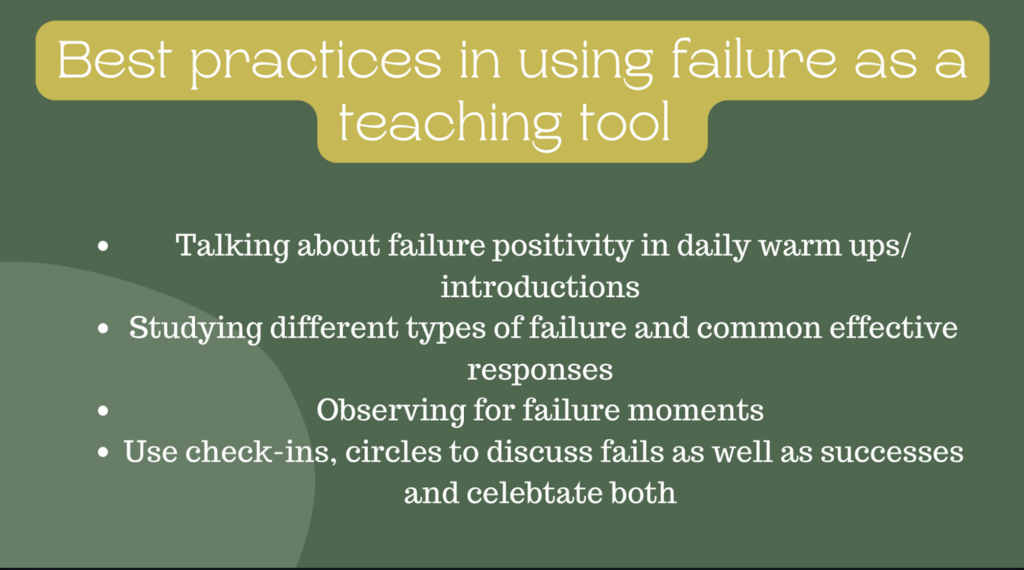
Failure is part of the learning process. We embrace failure. We call ourselves a “failure-positive environment”. When something doesn’t work or breaks, it becomes a chance to ask “why”. “Why didn’t that stand up?” “Why didn’t we complete this project in the allotted time?” Particularly since we do hands-on activities, we want participants to explore, define their own success, get frustrated, and learn to recover from that frustration. We think this is better than leading them through a sequence of failure-proof activities that results in something pretty but teaches little that will stick. We avoid criticism and tend towards suggestions, encouraging participants to define their own criteria for success that is at the edge of their abilities or just a little beyond. We talk about aiming for something “ambitious but achievable,” and that if it is succeeding every time then you aren’t finding the right balance between the two. We aim to get participants comfortable at that edge, including regular failures, and still remain optimistic and engaged in that discomfort. We work to decouple failure from disappointment or discouragement.
failure-based activity
The professional development centered on a weeklong tinkering camp held in a woodworking-centered makerspace. Over the course of the week, campers engaged in tool training, brainstorming exercises, and small projects, culminating in a large, collaborative build. Working in groups of three to four, about 15–20 campers co-created different components of a shared installation based on a theme they developed together—such as space adventure or journey under the sea. The final product often included a large wooden structure (sometimes skinned in cardboard or plywood), decorative elements, and costumes. This “Big Build” provided many opportunities for campers to practice iterating on ideas, negotiating collaboration, overcoming setbacks, and learning from challenges before presenting their installation to families at the end-of-week open house.
one failure moment or challenge
During our first year with Failure in Making, we took time during our summer camp training to introduce the research that would be happening at our Venice location. Then we told them that we would be recording facilitators interaction with campers to see how campers’ responded to failure. Being in front of a camera created a lot of nervous energy, as facilitators felt like they were being critiqued on their teaching. We did our best to ensure the facilitators were themselves and not nervous in front of the camera but we were on a learning curve behind the camera too. Our first few attempts both failed to capture the give and take between facilitator and camper that we normally saw and had some pretty unusable audio. We went back to reading the manual on the microphones and practicing with them and talked through with the facilitators to let them know the focus was not on them but on the campers. We let the camera run for up to 3 hours at a time which gave the facilitators time to get used to being on camera and relax into their regular facilitation behavior.
What did We learn?
When we reviewed the footage of campers and facilitators interaction, we noticed a lot of the time facilitators were able to deter the camper from responding negatively towards failure. This is in part due to great guidance by the facilitator on projects. When a camper seemed stuck on a project, they would often ask for help, both from fellow campers and from facilitators. We noticed that returning campers who understand that there are going to be mistakes were able to help get their peers unstuck. When campers did respond negatively towards failure, facilitators were able to for the most part calm the camper down using the chill zone; In our space, we have a chill zone that we let every camper know about at the beginning of the week. We frame the space as a place to take a break from their project or if they need any rest.
one insight or practice We Continue
We noticed that a lot of the time, facilitators were able to mitigate campers’ failures because facilitators saw what was going wrong and corrected the project; In other words, sometimes facilitators would do the project for the student without realizing they were. From this research, we are better about recognizing when we are doing the project for the camper and when we are allowing them to learn from failures. As one facilitator put it, if you do the project for them then you are stealing their learning. We have strengthened the part of facilitator training that focuses on why and how to be present to a frustrated camper without fixing their problem for them.
Adult Focused Study
Initial Questions and Interests
reDiscover’s Mission/Vision/Values Statement mentions in multiple places our goal of building a community that supports makers. While much of our impact was made through professional education staff working directly with youth, at the time, our work was expanded in thinking of reDiscover as the catalyst of makerspaces near and far facilitated by teachers, parents, and youth themselves. In particular, there was much more to do to develop pathways for adults to understand and support failure as an element of making and tinkering.
Some of our initial questions included:
- How do you help an adult shift from a product-oriented mindset to a process-oriented mindset?
- How do we quickly explain an adult’s role in youth making/tinkering? e.g. supporting vs solving the challenge for them
- What are we aiming for in training parent facilitators? What would success look like after a parent training program? What are the low hanging fruit of that success state that can be effected with nudges, cheap/fast interventions, and environmental cues?
- How can parents support their youth makers in a home setting? In a public makerspace/science center setting without facilitation? With facilitation?
In addition, the fact that this was a collaborative group of informal science educators thinking about failure-positive learning within a non-heirarchical research structure was attractive.
What Was your Research Focus?
In our research study, we aimed to understand barriers that parents and chaperones faced in engaging directly with hands-on making during our Weekend Family Crafting program.
Our goal was to decrease the number of parents helping their children to allow children greater independence and direct engagement with the maker materials, tools, design challenges, and open ended prompts.
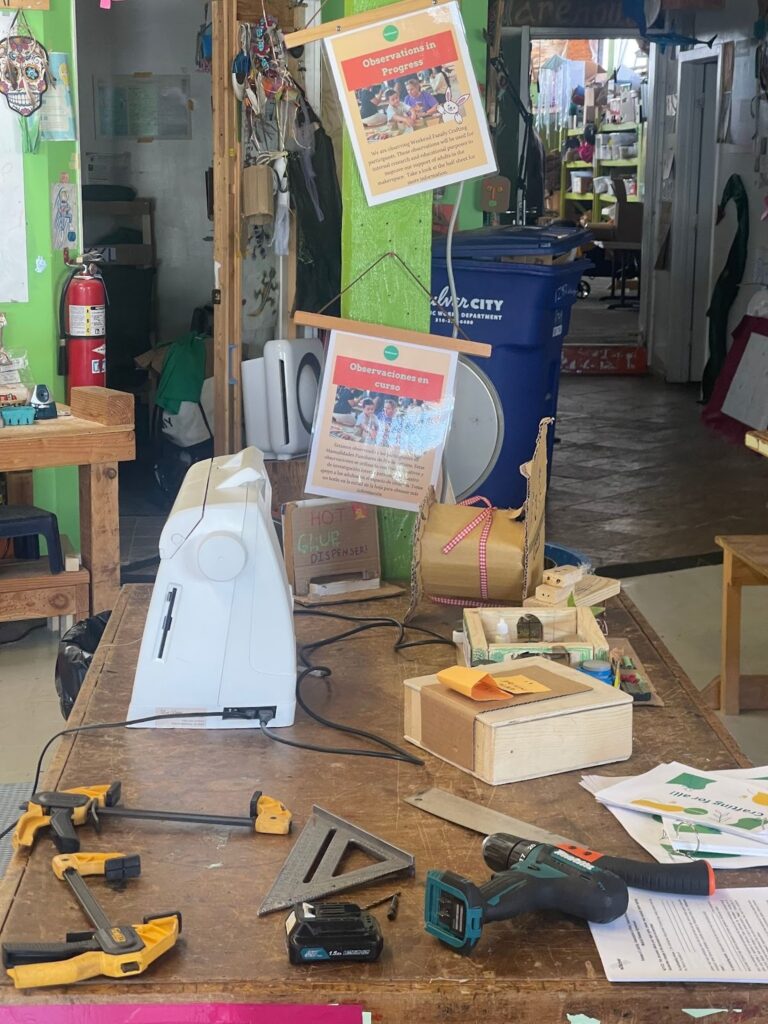
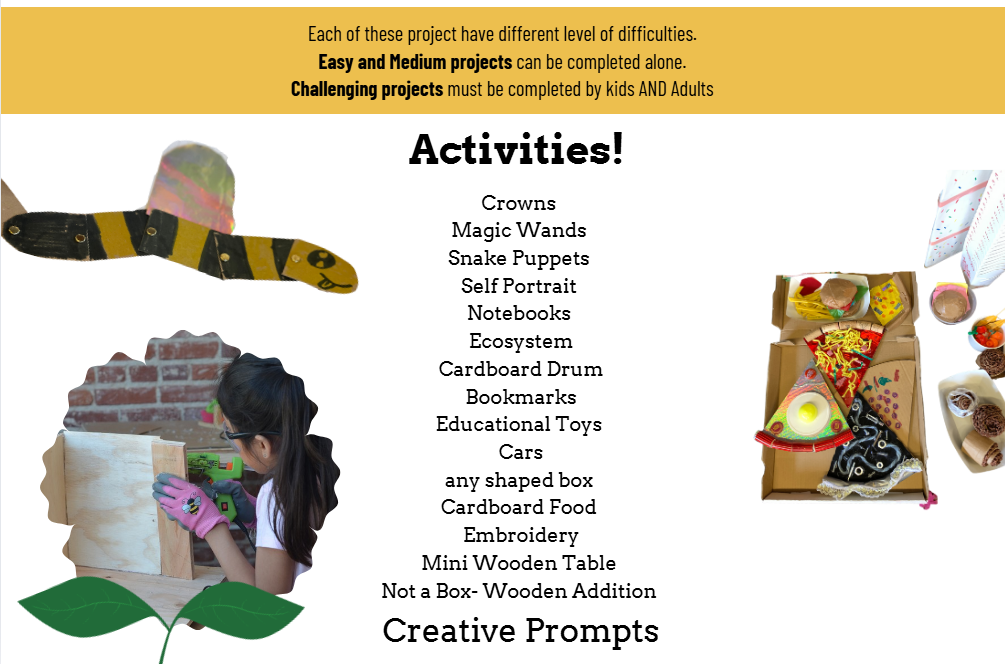
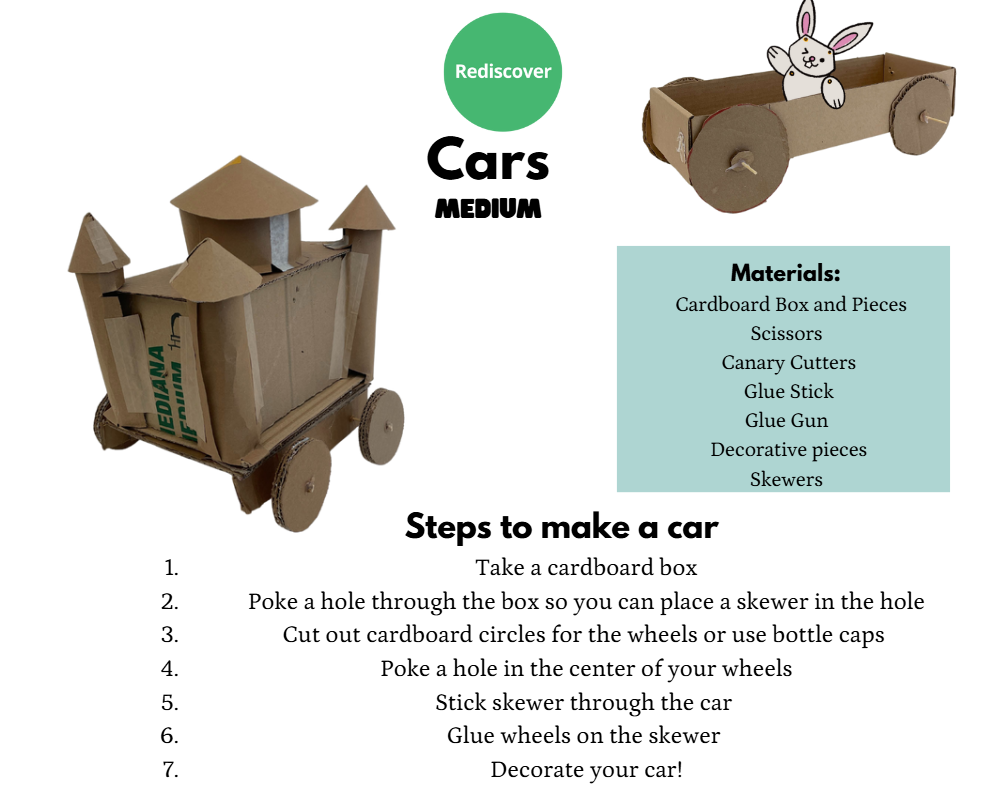
Through a four week baseline study in June 2024, we collected quantitative and qualitative data on adult engagement and worked with Rediscover Programs Team and Facilitators to brainstorm strategies to increase adult engagement with maker activities. We implemented six interventions: new signage targeted specifically at adult makers, changing the introduction/tool training curriculum to explicitly welcome adults to be makers, creating an activity booklet of adult-focused prompts, incorporating more advanced maker modes with the addition of limited adult woodworking, providing a warm-up activity design challenge intended for both adults and children, and changing the background music to appeal to adults ages 30-50.
What did your research highlight?
This study has helped us to understand the importance of serving adults, both for their own benefit and so that they can better support the youth they work with, and given us tools that help us to help those adults be more playful, failure-positive, and engaged with hands-on maker activities. We found instances of adults directly helping their child with their maker project decreased 47% while working on their own project increased 31% and other activities, such as disengaging with the activity or attending to a younger sibling, increased 40%.
Of the six interventions, four have become part of the permanent operations of Weekend Family Crafting: the modified introduction/tool training, cardboard strip challenge warm up, woodworking tools, and the parent activity booklet. In the interest of increasing youth engagement, the music selection reverted back to youth-centric music at the conclusion of the study.
What are the key takeaways of your research for the field?
Engaging parents to directly participate in makerspace activities in parallel to their children increases youth’s opportunities for failure-positive experiences, with the added benefit of also increasing the number of individuals fully engaged with makerspace activities.
About us
MISSION: Rediscover’s Mission is to provide makers with the tools, resources, and confidence to engage in creative reuse and self-expression. We educate youth of all levels of expertise in transforming discarded materials into art, functional objects, and tools for learning. We support one another as hands-on creators, problem-solvers, community stakeholders, and stewards of the Earth.
VISION: Rediscover envisions a culture of makers who contribute to building a creative and environmentally sustainable society. We provide affordable and accessible programming for all youth in Los Angeles. Our imaginative and resourceful staff create spaces–physical and mental–where everyone is welcome to explore their creativity without judgment.
As Rediscover nurtures creative reuse among makers, we move closer to a culture where reclaimed materials can be recognized for their educational and creative value. We achieve this vision by enhancing youth’s instincts and interests to use the available resources in their lives responsibly. By sharing our resources in a makerspace, we reinforce practices of sharing that strengthen our neighborhoods, city, society, and planet.