Discovery Place
Why Failure in Making?
We were particularly interested in this opportunity because it addressed challenges we had observed in our Make areas but didn’t yet have language or tools to solve. We often saw facilitators step in and take over projects, and while we would talk about these moments afterward, we didn’t have a clear framework for addressing them. This professional development offered a new perspective and practical strategies for supporting guest learning without taking over, as well as ways to incorporate these ideas into our staff training.
In our classes and workshops, iteration has often played a large role in the design process in the past, but we were not actively training our staff to recognize guest behavior during iteration or underscore the importance of it. We were collectively pushing guests to finish their projects and missing out on valuable teaching opportunities. We regularly had guests getting frustrated with their projects and giving up. Now that our staff is more familiar with recognizing these moments and seeing them as an opportunity to teach, we’re seeing many more lightbulb moments in our guests. (Lead Facilitator)
What is Failure
Our work led us to see failure as much more than simply making mistakes and learning from them. We began to think of failure as an opportunity to analyze what went wrong, intentionally build on those insights, and create future successes from what we learned. Through this process, we also recognized that failure is a sensitive and deeply personal experience—different for every person.
failure-based activity
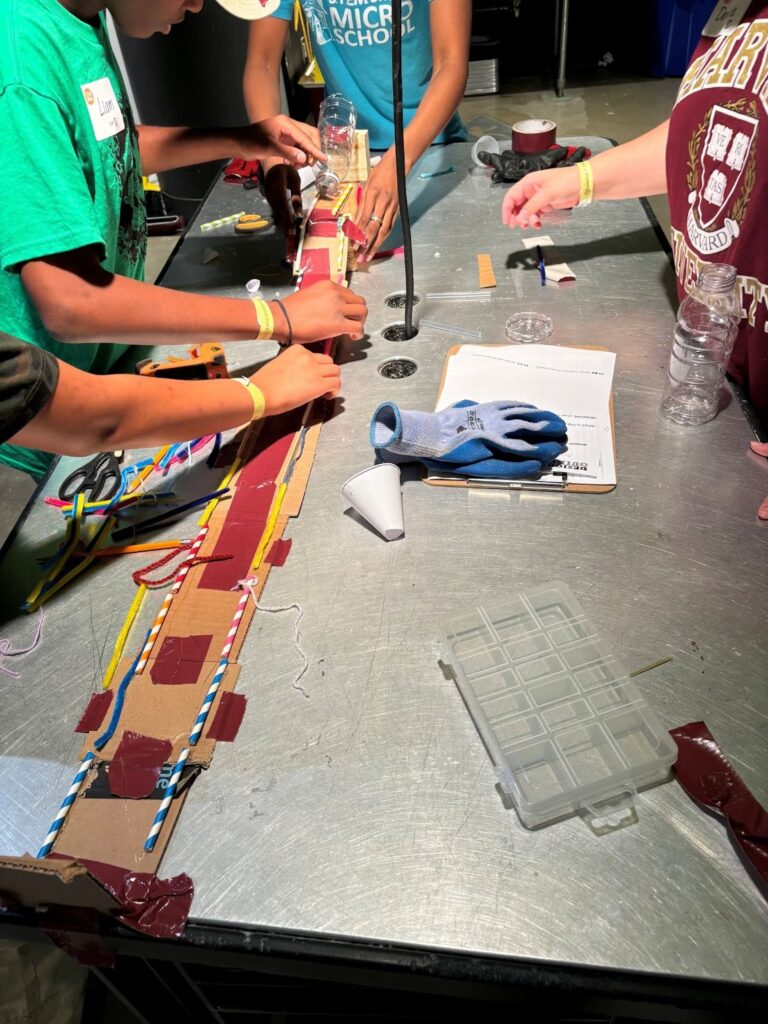
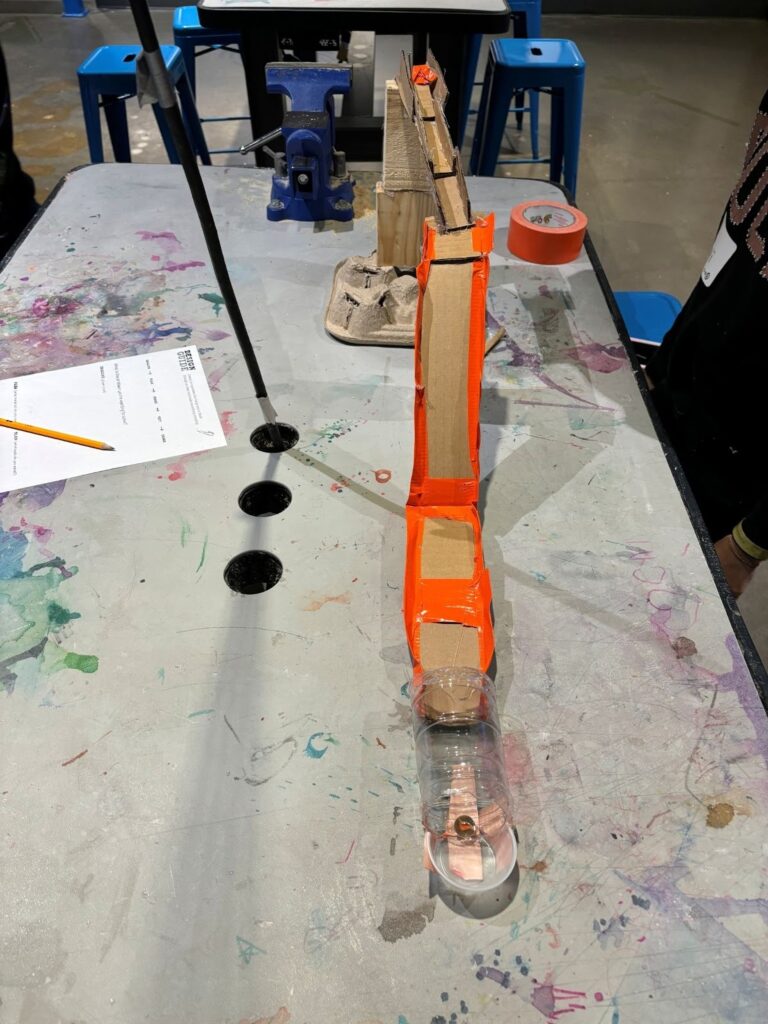
My team focused on creating safe spaces for failure and bringing failure opportunities into lab spaces, classes, and workshops at Discovery Place. One focus in particular was a STEM Design class called “Physics in the Making.” Students learn about simple machines and work together in teams to build a Rube Goldberg device. This class is the first of its kind, as it is the first class we’ve offered that allows school groups to use tools. Students are allowed to use hammers, non-electric saws, glue guns, and power drills to help them build their creation. The goal is for students to build simple machines that will help them get a marble from one side of their table to the other by the end of class. The constraints? They have a limited amount of time and resources, and many opportunities for failure!
Building simple machines, engineering with recycled materials, using tools, and collaborating with their teammates all proved to be excellent opportunities for students to work through failure (and for educators to practice guiding them through frustrating moments!)
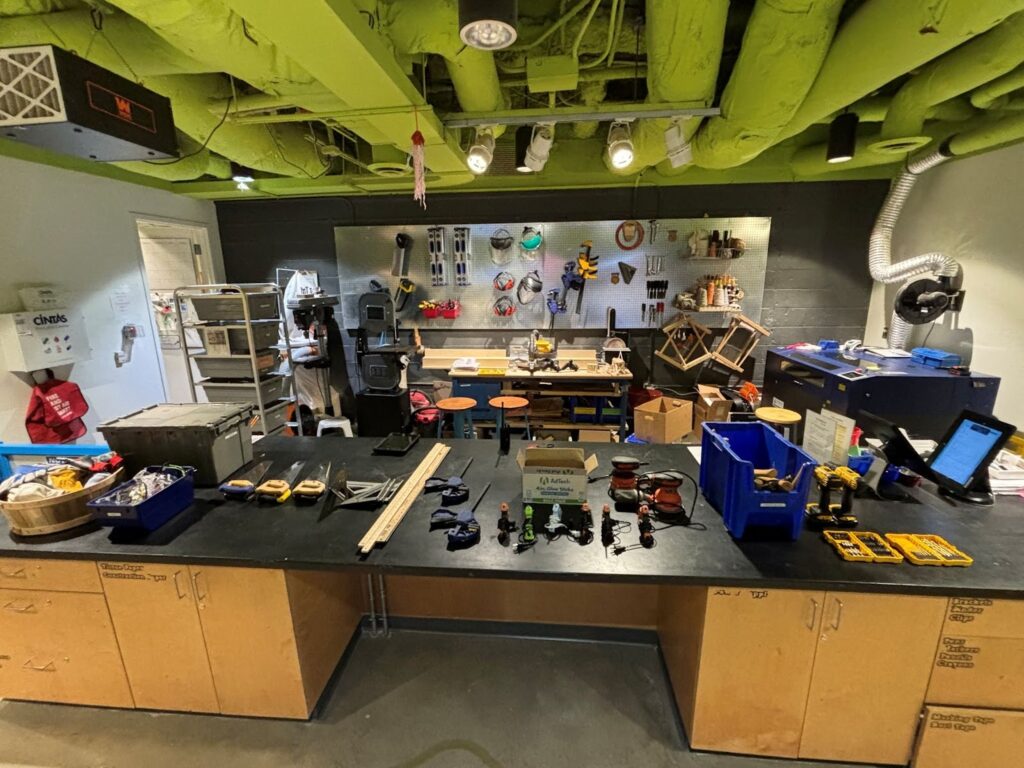
Physics in the Making was not the only activity that we included the Learning Through Failure philosophy in. We offered a “Wearable Technology” activity in our Thinker Space lab that focuses on the intersection of technology and design. Guests were incorporating circuitry and 3D printed parts into functional fashion. Later in the summer, we also visited the “Grand Engineering Challenges of the 21st Century” in a segment that touched on building strong structures, renewable energy, and designing filtration and irrigation systems that get clean water from one place to another. All of these design challenges allowed makers to get into creative problem-solving mode and maneuver complicated failure moments. We eventually turned the water filtration and irrigation challenge into a class and have started offering it to school groups in FY26.
One Failure Moment or Challenge
One failure moment I encountered had to do with our Physics in the Making class. Often when I’m designing a class, I need to prototype it more than once to see what areas are weaker than others and which areas need to be adjusted. I initially thought it would be a great idea to include electric sanders in the list of tools school groups could use but quickly learned that we needed to pivot. In the first couple of classes that I taught that included this tool, students stopped focusing on simple machines altogether. Students were fighting over the electric sander and not using it to really improve their Rube Goldberg at all. They would spend all class sanding wood and end up without a working final project. Moving forward, taking out that one tool changed class dynamics completely. Students became competitive and focused on the challenge in front of them. They could still use all the other tools (which they did), but in a way that was intentional and created real, measurable results. This helped me recognize that not every moment is an opportunity for every tool, and that I need to be more considerate about the challenges I create and the tools that I offer alongside them.
What did We learn?
A year later, we are still talking about our Failure in the Making work at Discovery Place. We’ve continued to have failure moments (big and small) and what we’ve managed to carry with us through this experience is the ability to work through each failure moment in a productive and thoughtful way built on empathy and resilience. We actively recognize “ideal failure moments” in our work and use them to catapult us forward. Before our FiM work, most of my team was too afraid to admit failure, and it was a touchy subject. Now we regularly call out failure moments and work as a team to find solutions.
The Failure in the Making philosophy can be used not just in making, but in all aspects of life. This year has been a very difficult year for many, and I know the work we have done has been meaningful and helpful. My teammates and I no longer look at failure as a bad thing, but an opportunity for growth and change.
one insight or practice We Continue
One key practice we have carried forward is incorporating these ideas into our Standard Operating Procedures (SOPs) for the Making and Engineering areas. These updates clarify how staff should recognize and respond to moments of failure—supporting guests without taking over—so that failure is treated as a valuable part of the learning process rather than something to avoid or minimize.
About us
MISSION: We bring science, nature and design together to create transformative experiences that enable our community to understand, enjoy and apply science to their lives.
Discovery Place is a 501(c)(3) nonprofit and a hub for science education and exploration in the Carolinas with four distinct museum experiences serving more than 750,000 people a year through museum visits, interactive educational programming and community outreach initiatives.
We aspire to shape a future where people embrace science to create opportunities, build hope, solve problems and bring positive change for our world.