Montshire Museum of Science
Why Failure in Making?
We work with families everyday, facilitating intimate and hands-on experiences. One of our goals is to support families learning together, and one aspect of this is adults being confident in helping their children learn, though a challenge in this is that not all parents, or other caregivers, see “failure” as learning. We want all adults to understand the importance of failure and how to help their children work through challenging moments in learning.
Being able to look over my own experiences from a more external and objective lens has given me a much better picture of what I struggle with as an educator versus what I have down pretty well, and what I should pay more attention to trying to change. I think that will be really valuable moving forward. (Educator, Year 2)
What is Failure
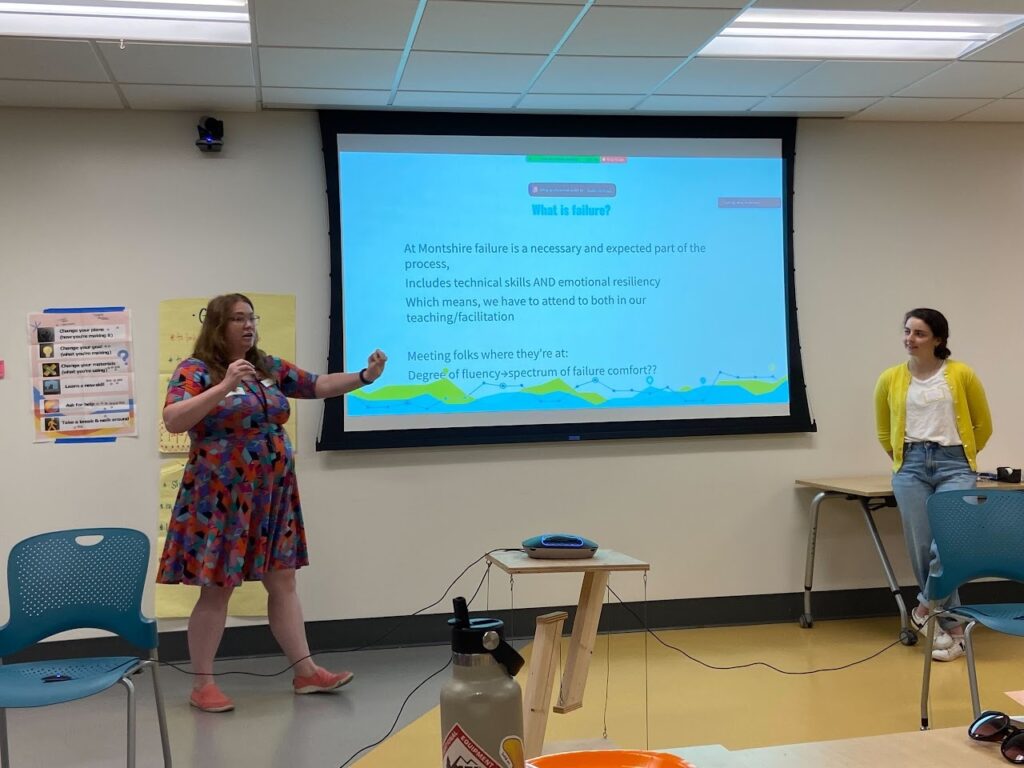
Failure is a necessary and expected part of the process. Moving through failure includes technical skills AND emotional resiliency. We must attend to both in our teaching and facilitation.
failure-based activity
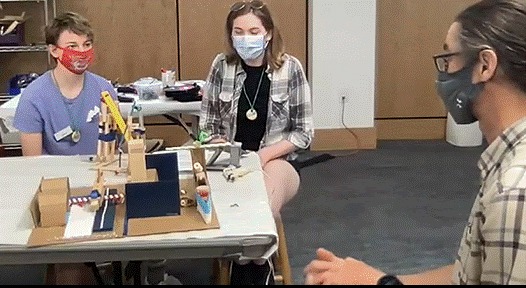
We conducted our PD cycle in our Inventors’ Workshop, a camp for children in grades 5-6. Inventors’ Workshop is perfect for those who like to create, design, experiment, and take on exciting engineering challenges while engaging in fun, hands-on projects. Campers sketch ideas, troubleshoot designs, and bring their imaginations to life through their inventions.
one failure moment or challenge
In the first year, we placed tablets on the tables and noticed how this was not the best approach as things were placed in front of the tablet/camera or it was not focused on any one kid. We captured a lot of conversation, but not able to judge the nonverbal actions such as if the instructor took over and grabbed the project. In the second year, we designed a lazy susan approach which allowed educators to turn and move the tablet/camera around to capture the learners and avoid the obstruction of objects.
What did We learn?
First, we learned it is possible to teach campers how to (a) fail without thinking “I am now a failure”; (b) get “unstuck”; and (c) normalize that they will get stuck.
Second, educators express the following learnings: (a) The getting unstuck list was their friend. (b) Failure buckets were helpful to understand failure as an “object” and not as a way of being (e.g., I failed, I am not a failure.). (c) Understand that failure raises feelings of shame, guilt and embarrassment. (d) Have self-compassion (i.e., treat yourself like a friend). (e) Connect to the emotion another person was experiencing, and not the situation.
Third, as facilitators, we learned to (a) set clear expectations for quality and type of video we wanted to collect, as well as self-reported data methods. This should be based on what failure looks like in the FiM projects. (b) Time! Build in a week when educators do not have teaching responsibilities so they can devote time to reviewing videos. (c) Have more conversations with summer staff around understanding feelings of shame, guilt and embarrassment. (d) Rejecting perfectionism is really, REALLY hard. (e) Striving for excellence is the goal. Care must be taken to give nuance to what excellence looks like. Don’t create a rubric where educators and facilitators are only happy with a “perfect” score.
one insight or practice We Continue
We have learned and discussed how we can identify actions that show adults are struggling to help their children to work through challenges and “failure” in learning.
Adult Focused Study
Initial Questions and Interests
At the time of this collaborative opportunity, a growing focus of the museum was how we supported workforce development. In many conversations with local STEM professionals, the concept of “failure” came up regularly in how they go about their work. We saw lots of opportunities to be able support learners and adults in how they approached failure, and how they could be more resilient learners and become prepared to be part of the future STEM workforce.
We also had an interest in helping adults learn how they can support their children and students. We would approach this as not looking at adults as obstacles, but rather as an audience. We wanted to find ways to let adults know that when a child was struggling, that was a part of the learning process, so how can they help their young learners through their challenges without taking away that learning experience. The professional development that would come out of these conversations would be immensely helpful to us as professionals as well as those in the communities we serve.
What Was your Research Focus?
We observed the interactions between children and their adult care-givers (parents; grandparents; au pairs; nannies; etc.) during our Science Discovery Lab programs. These programs occurred several times a day (2 or more times M-F, about 4 times on weekends and holidays, and more over the summer) in a space dedicated to facilitating activities led by a museum educator or volunteer. The results below come from observations made by staff educators during mostly engineering programs, but also natural world programs or the physical sciences.
What did your research highlight?
Some of the behavior we identified in adults that indicated they were struggling with facilitating the learning of the children in their charge included:
- An adult taking over, or doing it for the child (“it” being whatever the activity is)
- An adult telling a child they are “not doing it right”, or “that’s not how it’s done”, etc.
- Child getting frustrated, and adult encouraging child to move on to another activity
- Adult is bored and hurries their child along
- Adult lets child do whatever they want, which may interrupt others’ experience
- Child loses interest, and adult lets the child take the lead to move on to another experience
- Adult felt that the activity was too high-level for their child and they left
What are the key takeaways of your research for the field?
- Either for an individual institution, or the field as a whole, it is helpful to make sure there is a shared understanding, or definition, of what “failure” is, or how to identify moments of struggle.
- Each institution should have a strategy for working with visitors to help them understand how to support their children as they struggle through learning challenges.
About us
The Montshire Museum of Science is a regional science center serving children, families, schools, and adult learners in Vermont and New Hampshire.
MISSION: The Montshire’s mission is to awaken and encourage a lifelong interest in science through exhibits and programming dedicated to hands-on discovery and education for people of all ages.
The Montshire carries out its mission of forging and empowering lifelong learners by engaging people in hands-on, inquiry-based science. Their mission drives the Montshire to help people think deeply and critically about the world around us. By fostering curiosity, new perspectives, and a meaningful exchange of ideas, they work toward positive change in the world, and against injustice. The Montshire believes in science as a means toward greater understanding of the human condition.