Oregon Museum of Science and Industry (OMSI)
Why Failure in Making?
We were in a moment of transition post-pandemic and rebuilding our education team. To this end, we hoped to utilize this training as another tool in building our staff’s confidence for framing activities and attitudes, facilitating learner-centered activities, and encouraging iteration.
Not only did they [informal educators] develop empathy for the learner and the failure experience, but they also built empathy within the team and appreciation for each other for working with the public in this particular setting–that was the most valuable part of it from my perspective. (Lead Facilitator)
What is Failure
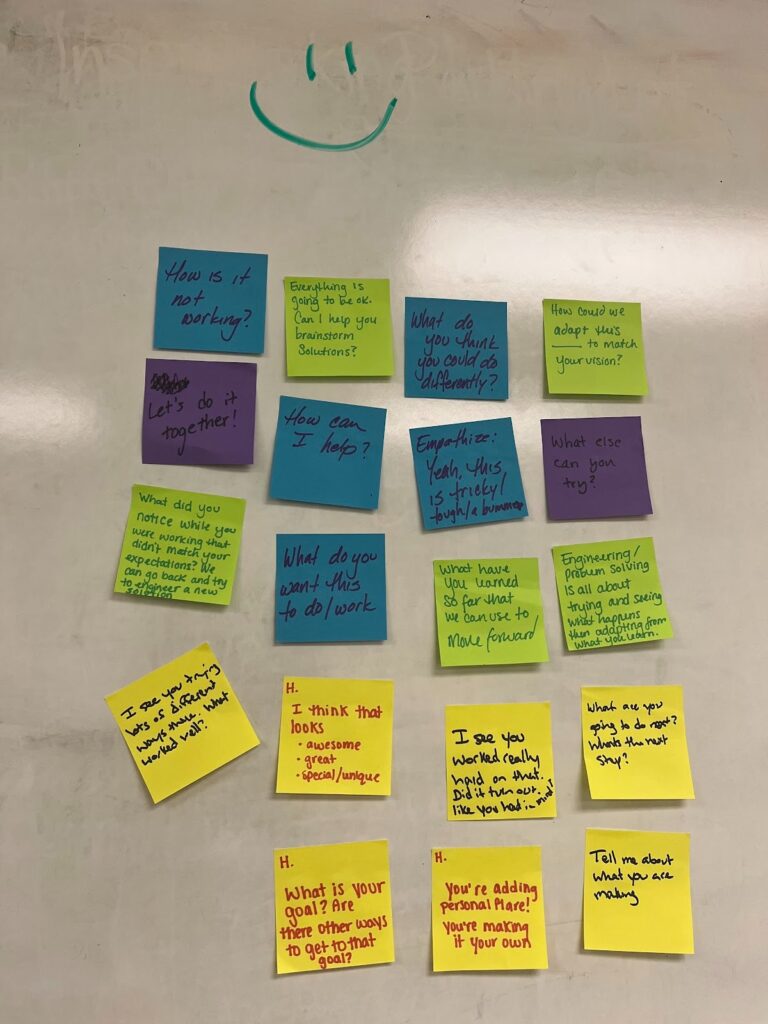
At the start, failure was often seen simply as giving up when something got hard. Staff would sometimes reframe something that was not working as intended as: “We’re not afraid of failure—we’re excited to learn from it!” Through the professional development program, we could not develop a shared definition of how to talk about failure but motivational language included (a) “Let’s just try it!”, (b) “What’s the trickiest part of that”//”that’s really tricky”, and (c) “Where did you get stuck, and how did you get unstuck?”
failure-based activity
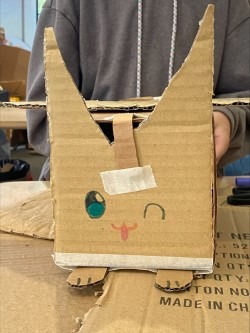
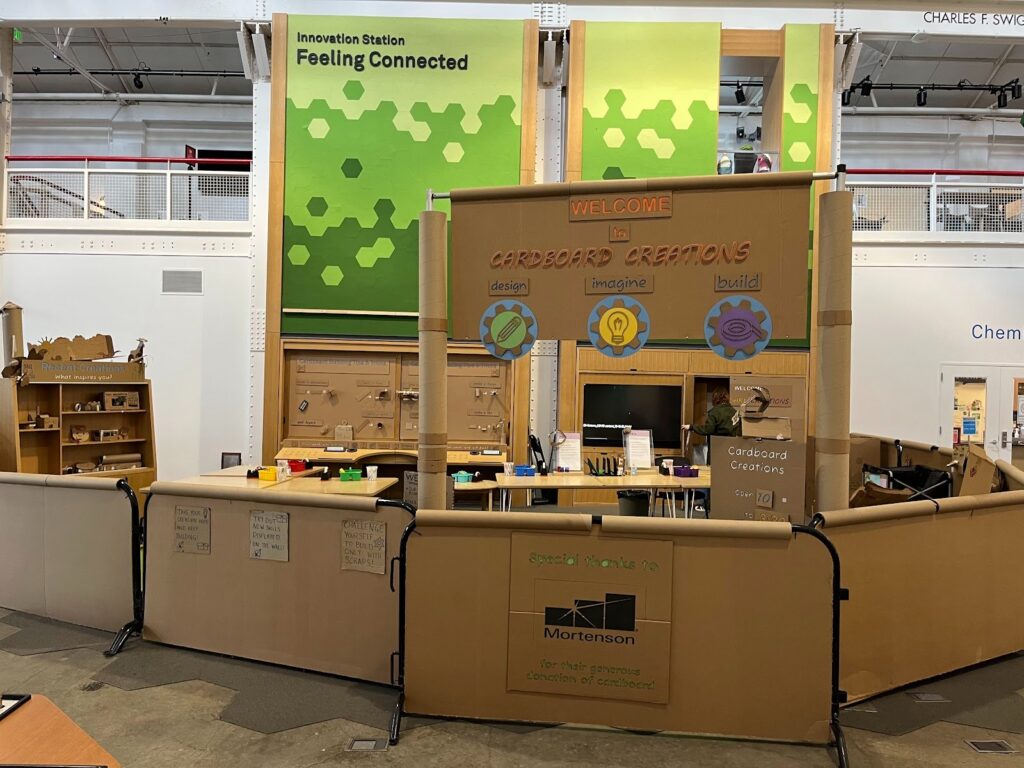
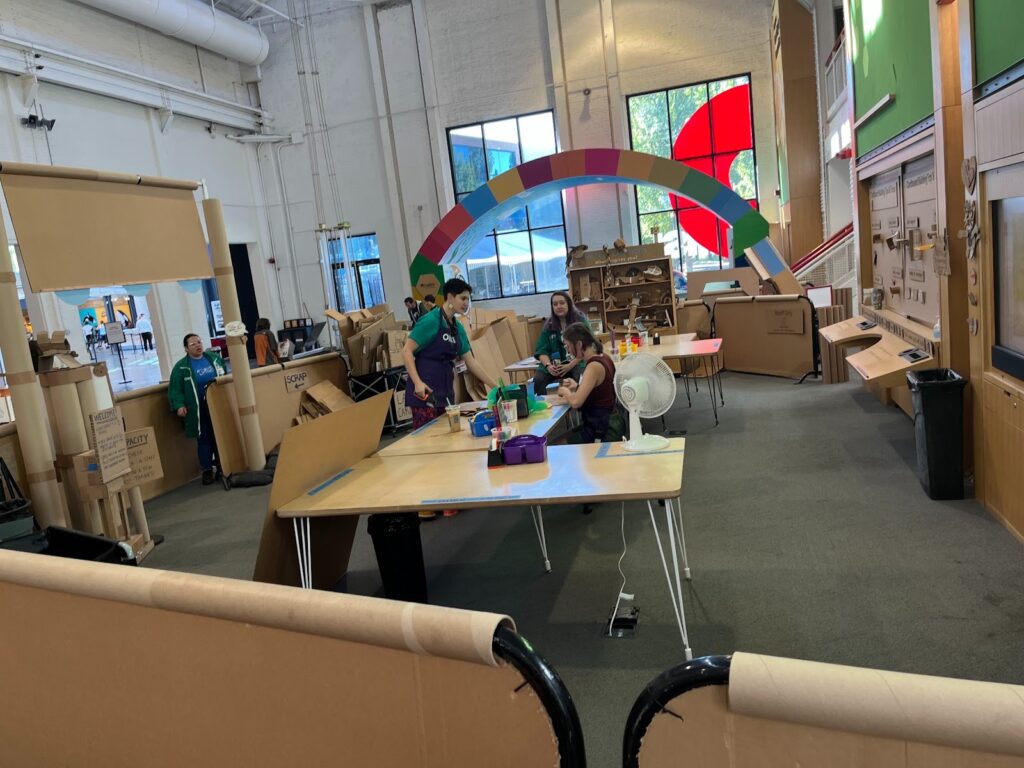
The professional development focused on a hands-on engineering experience called Cardboard Creations, a temporary pop-up program where participants explored the design process through open-ended building. Using cardboard, tape, and safe cutting tools, participants could build anything they imagined, with light scaffolding provided through daily suggested activities. For the failure-focused PD session, we centered on one of these guided activities: building an animal that could stand on its own. The activity was intentionally structured to surface moments of trial and error, inviting participants to experience “failure” as part of the creative process and reflect on how to navigate setbacks.
one failure moment or challenge
One notable challenge occurred when an educator worked with a child whose parent was highly focused on immediate success and hesitant to let the child fail. These circumstances made it difficult for the child to engage in trial and error; had the child been working with an educator alone, the adult might have been more hands-off, allowing for more independent experimentation. More generally, time pressures and distractions—such as needing to move on quickly or attend to other children—also complicated opportunities for failure. To meet this challenge head on, we became a part of a networked improvement community in which we engaged in our own action research study with the support of the FiM research study and five other organizations.
What did We learn?
We did a survey at the end for educators to share their thoughts on the program and how they grew as educators. We included quotes from our staff involved in the professional development cycle.
- It felt vulnerable and sometimes uncomfortable to share my teaching with my colleagues, but I felt very supported and encouraged by them. Some positive impacts were the opportunities we had to share our experience and learn from each other.
- The thing that I notice has changed in me most is my level of meta-cognition, so I would say that definitely has been the most significant impact. This was caused by the careful analysis of each moment that was chosen, and the opportunities to reflect on each of the analyses. If we didn’t analyze and reflect like we did, I am confident that I wouldn’t be so critical about my choices as I am now that it is over.
- I was able to think critically about my actions. Normally I just go about my day and take things as they come without really thinking too hard about them. Now, when I facilitate, I constantly am checking in with myself about the effect of my actions and strategies. In other words, I am significantly more meta-aware.
- One positive impact is that I was able to take advice from my colleagues in a way that I wouldn’t have thought to otherwise. Of course, I knew that each of them were effective facilitators in their own way, but without this training module I don’t think I would have ever learned those tactics from them in this capacity.
- The most impactful piece of Failure in the Making for me was practicing reflection and being able to analyze and revisit interactions during key failure moments.
one insight or practice We Continue
One of the biggest takeaways from our team that I see the participating educators still using is being more reflective in their facilitation practices. They consider the how and why of different interaction strategies. They are also less worried about a museum guest or program participant not getting something “right” in an activity and feel more confident supporting the process. Additionally, going through the vulnerable process of watching videos of each other created a lot of trust among the educators, creating a more supportive team.
Adult Focused Study
Initial Questions and Interests
A challenge that our educators often noted during FiM video review was how to negotiate interactions with groups of adults and children when an adult might take control over an opportunity for a child to struggle and grow through failure. Institutionally, we have done research and created professional development related to this about negotiating family and educator goals in exhibit facilitation, and research about young children’s development in which educators narrated developmental skills to parents as their children participated in activities. Open-ended maker activities require different facilitation approaches, and families approach the activities with different mindsets than when interacting with a close-ended exhibit. We were curious how strategies for facilitating multigenerational families at open-ended challenges might combine with giving parents direct insight into personal growth through moments of failure.
What Was your Research Focus?
Through our collaboration, several museum partners observed that educators often faced challenges when facilitating moments of failure with adults in family groups. These observations highlighted a gap in the literature: little research has examined how educators and families interact during moments of failure in informal learning settings. Our research addressed the following: What specific strategies are useful for engaging adults and children working together during a STEM-related activity?
What did your research highlight?
Analysis of observation notes and reflection forms revealed five strategies that educators consistently experimented with and discussed across reflection sessions. These strategies informed the educators’ weekly goals and were continually refined and adapted as they interacted with family groups on the floor. These strategies included: (a) initiating dialogue to create space for shared participation, (b) inviting non-engaged group members to join, (c) assigning roles within the activity, (d) using inclusive, team-oriented language, and (e) intentionally alternating between active interaction and stepping back to give the group space.
What are the key takeaways of your research for the field?
The strategies we present contribute to the growing body of knowledge on how to engage both children and adults as co-learners in iterative, design-based activities. We see these approaches as promising practices that other museum educators can adopt and adapt to support family engagement—especially during moments of failure—promoting richer participation and collaboration.
About us
We create learning experiences these walls can’t contain — bringing science to as many people as possible, no matter who or where they are. OMSI believes our collective potential can be unlocked when curiosity, learning, and community unite. Our differences are what make us amazing, and we celebrate those who dare to question: the explorers, the tinkerers, the storytellers, and the innovators.
OMSI’s mission is to inspire curiosity through engaging science learning experiences, foster experimentation and the exchange of ideas, and stimulate informed action.
Our vision is to collaborate with partners to ignite an education transformation at the intersection of science, technology, and design. We will weave a thriving innovation district into the fabric of Portland that spreads opportunities across the Northwest.