Tag: Planning

  • Facilitating Discussions

    Facilitating Discussions

    You must be willing to participate and be vulnerable. It has been suggested from our partnering sites that you as a facilitator start this process with a video clip of yourself engaging with youth in a STEAM-focused making activity. 

    How will you introduce norms? How will you incorporate educator and/or team goals? How will educators introduce their video clip (e.g. provide context or other background)? 

    From our experience, educators tend to focus on positive aspects of how their colleagues respond to youth’s moments of failure. How might you support educators in providing constructive and not evaluative feedback to one another?

    Keep in mind (a) the “fear” and focus that many will have on their own practices and (b) tensions between ideal learning experiences and pragmatic realities. Acknowledge but try to reframe to focus on learners.

    How would you redirect a conversation focused on student misbehavior? How would you navigate a conversation that positions the educator as a “failure”? How would you build upon a conversation that is focused on how the educator’s response to the child’s failure shaped the child’s project? What might you do if a video shared is void of youth’s failure moments?

    Will you gather student data within your STEAM-making activities and utilize them in these reflection sessions? How might you introduce student data as a form of feedback? What questions might you ask to support educator’s reflection on their pedagogical practices through student data?

    How will you end your reflection sessions? We suggest providing time to reflect on the session (e.g., feedback given and received) and individual and/or team pedagogical practices around youth’s experiences with failure. This could be quiet time and/or a discussion.

  • Example Agendas

    Example Agendas

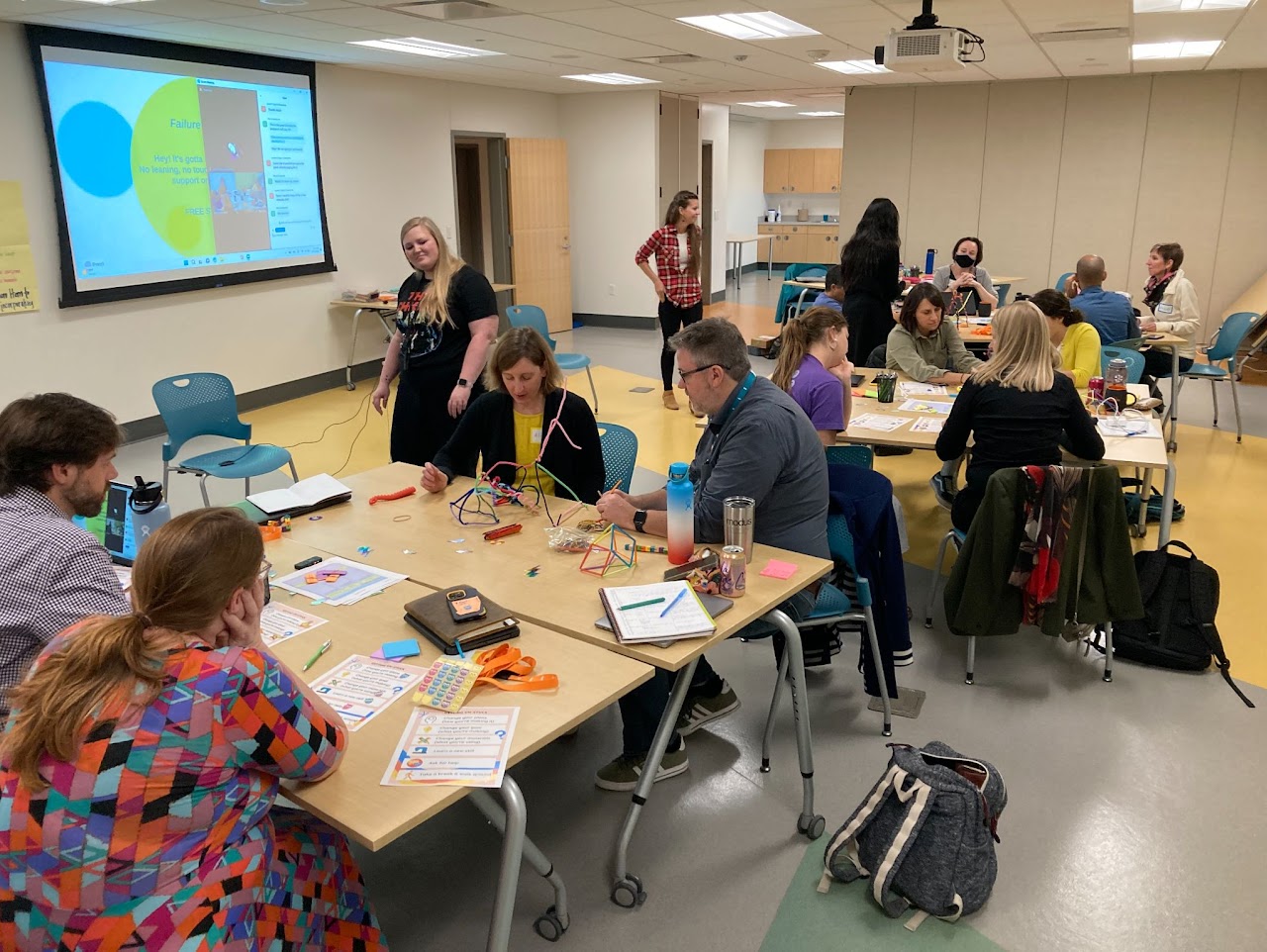
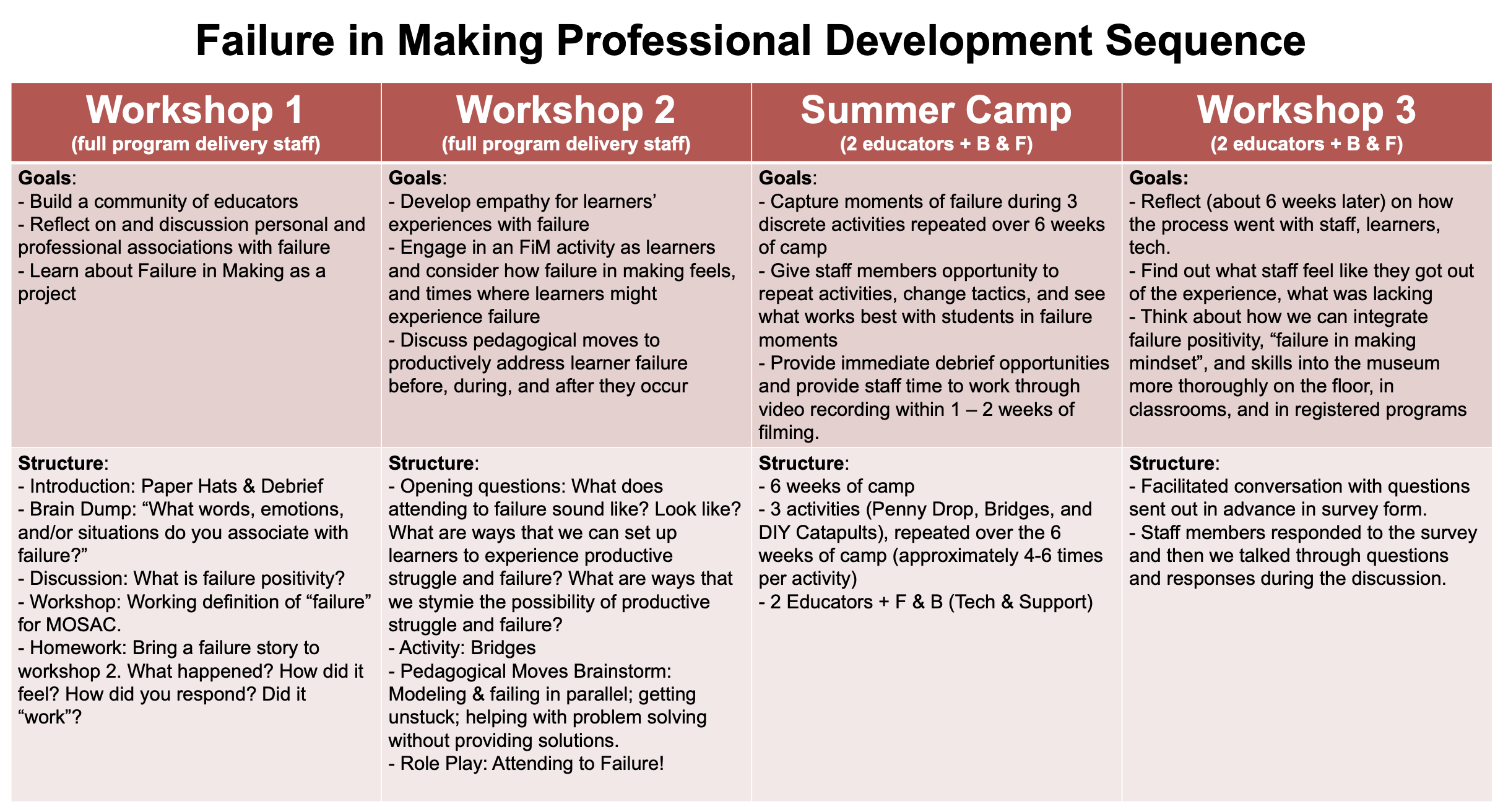
    Description: The original PD was organized and presented as four workshops: two setting context workshops, filming, two reflection workshops. Here are some example agendas and schedules used by various partners.

    Created by: Children’s Museum Houston, Children’s Museum Pittsburgh, MOSAC, Scott Family Amazeum, The Tech Interactive

    Logo for Children's Museum Houston

    Setting Context:
    1. Introduction, No-Look drawing, Duct Tape Drawing (30 min)
    2. Paper Hats, Failure Definitions (30 min)
    3. Balancing Sculpture activity and reflection, Failure Scenarios (45 min)

    Recording Practice: 3 educators ended up recording using a museum’s cell phone and a clip-on microphone. Set up to focus on the testing station of the balancing act.

    Reflection: Educators reviewed their own videos and sent lead facilitator their selections, which were edited together into a single video. Lead facilitator also watched the videos and sometimes expanded the selections they made or cut little parts out of it.

    Logo for Children's Museum of Pittsburgh

    Setting Context:Two workshops 45 min each. Talked about grant and failure and making (with activities): (a) build a grabbie, (b) would you rather, (c) build-and-pass, (d) wheel of fortune conversation, (e) learner type card game, and (f) blind contour drawing exercise.

    Recording Practice: Educators in camps chose which days/activities would be the best to film in (e.g., opportunity for failure). Interns and lead educator did filming with iPad and lavalier mic. Interns made notes about potential failure moments. Staff in Learning and Research department cut clips and had final say of which clips were discussed. They did NOT ask educators to select own clips because they did not want to add to the educator’s workload or add more anxiety to them.

    Reflection: Established norms to follow when viewing video clips. Clips were not reviewed by the educator before hand; done in the moment only. The “star” of video spoke first about what they noticed; other discussion followed; additional context provided when needed/able to.

    Setting Context:Two workshops, each was ~45 minutes (see below)

    Recording Practice: Video recorded each educator 3 times

    Reflection: We gave a 15 question survey prior to the workshop and about 2 hours of time to reflect and think deeply about the questions, and then used to facilitate the discussion.

    Setting Context:
    1. Introduce project, what is failure? (1.5 hrs)
    2. Failure Deep Dive (2 hrs)
    3. Reflecting on Failure Moments (1.5 hrs)
    4. Filming and Reflection Logistics

    Recording Practice: Video recorded each educator twice

    Reflection: Failure Party! (~2 hrs)

    Setting Context: Experiencing Failure, Failure Scenarios (see below). Year 1 this was in two workshops, Year 2 just one.

    Recording Practice: Year 1: Camera at testing station but Lead recording. Lead picks edits/picks clips down to 1-3 minutes and send them directly to educator; rough footage is about 30 minutes to 1 hour
    Year 2: Educators set up and recorded 1-4 labs each, could be between 60-90 minutes depending on the lab.

    Reflection: Year 1: 2-3 educators shared their Effective clip & all but one choose to share their Non Effective clip.
    Year 2: two sessions, first for educators not staying over the summer and another for educators staying over the summer. Shared effective & non-effective clips.

  • Project Description for Teachers

    Project Description for Teachers

    Suggested by: The Tech Interactive

    Description: This is a short blurb that describes the project. There is an emphasis on improving upon their educational practices.